

Tag Archives: Author Feature

Going Rogue: Agent Heather Slade Breaks Into an Asylum in Kimberley Troutte’s Latest Release – The Intel

I’m thrilled to announce that Book 3 in The Infiltrix series—The Intel—will be released on June 18th! This near-future spy thriller continues the high-stakes journey of undercover American agent Heather Slade, as she faces her most dangerous mission yet.

And trust me… this one is a wild, intense ride.


Heather is back with her elite crew of spies, hackers, and recon operatives—Mike, Hammer, Raven, Rat, Roman, and Worm. She trusts them with her life. But when innocent lives are on the line, Heather is willing to go rogue—even if it means breaking every rule in the book.

This time, she uncovers fragments of intel about a secret prison camp run by some seriously bad actors. When her search leads to a critical mistake and her fake father is captured and locked in an asylum, Heather launches a desperate rescue mission. But HQ has other plans: they’ve issued a kill order to silence him before he can spill any secrets.

Will anyone help her defy orders, break into the asylum, and get out alive?

Writing this series has been an absolute thrill. One of the things I’ve loved most is exploring morally complex characters. Heather and her team are far from perfect—they make mistakes, take risks, and blur the lines between right and wrong. That’s intentional. I wanted to create characters who feel real, whose choices make us stop and ask: What would I do in that situation? Which side would I be on?

If you love action-packed spy fiction, emotional depth, and flawed heroes fighting for what’s right in a world that often isn’t, I hope you’ll dive into The Infiltrix series. And if you’ve already started, get ready—The Intel is the most explosive installment yet.

Mark your calendar: June 18.
Agent Heather Slade is going rogue… and you won’t want to miss what happens next.


About the Author

Kimberley Troutte is a New York Times and USA Today bestselling author. She has been a Top 100 Amazon author and a Top 10 Romantic Suspense bestselling author for Amazon. Kimberley was a finalist in both the Vivian® and  the RITA®–the highest awards for excellence in romance. She lives in Southern California with her husband, two sons, a wild cat, a large iguana, an old snake, and all the other creatures that hubby and boys rescue.

To learn more about her novels, please visit her at www.kimberleytroutte.com and sign up for the newsletter.
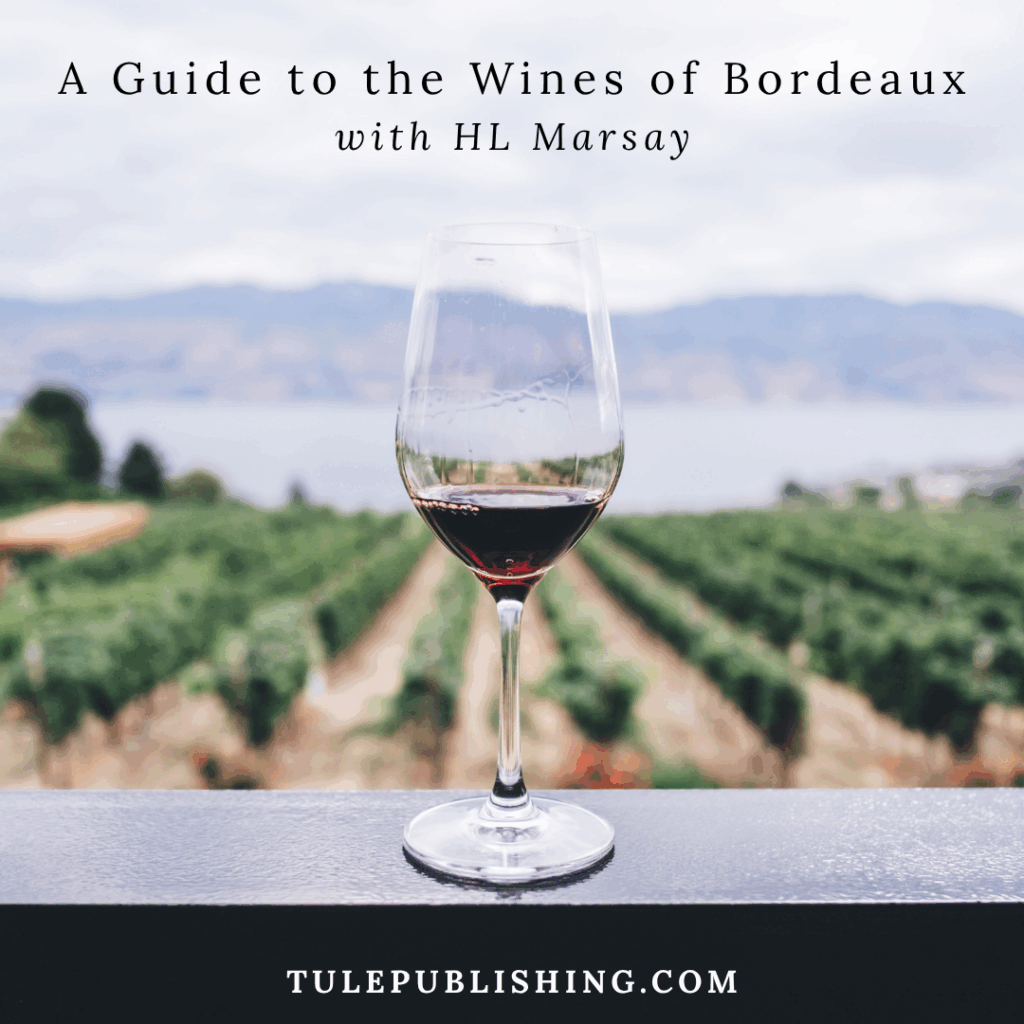
A Guide to the Wines of Bordeaux with HL Marsay

The region of Bordeaux, located in southwestern France, is one of the most influential wine regions in the world. With a winemaking history stretching back over 2,000 years, Bordeaux has shaped global wine culture through its complex blends, iconic estates, and pioneering classification systems. From the Left Bank’s regal cabernet sauvignons to the Right Bank’s plush merlots and the sweet nectars of Sauternes, Bordeaux represents a vast and varied vinous tapestry. Its wines are expressions of geography, climate, and human artistry.

The Romans were the first to plant vineyards in Bordeaux during the 1st century AD. By the
Middle Ages, Bordeaux wines were already being exported, particularly to England after the 1152 marriage of Eleanor of Aquitaine to Henry Plantagenet, the future King Henry II of
England. This political union sparked centuries of commercial ties between Bordeaux and the British market, fostering the international reputation of “claret”—the term the English used for the region’s red wines.

In the centuries that followed, Bordeaux’s fortunes ebbed and flowed with wars, plagues, and trade dynamics. Yet it was in the 17th and 18th centuries that the groundwork for modern Bordeaux was laid. Drainage of the Médoc marshes enabled large-scale viticulture on what would become the Left Bank’s most celebrated terroirs. The 1855 Classification, organized for the Paris Exposition under Napoleon III, further cemented Bordeaux’s prestige by ranking the top châteaux according to price and reputation—a system still largely in place today.

Bordeaux is situated near the Atlantic coast, with the city of Bordeaux serving as the
commercial hub of the region. The region’s geography is shaped by the Garonne and
Dordogne rivers, which converge to form the Gironde estuary. These rivers not only influence the local microclimates but also divide Bordeaux into its famed Left Bank and Right Bank subregions.

The climate is maritime, with moderate temperatures, ample rainfall, and a relatively long
growing season. This enables the cultivation of both red and white grape varieties. However, the humidity also poses risks, particularly for diseases like mildew and rot. In the case of sweet wine production, however, the same humidity plays a vital role in encouraging Botrytis cinerea (noble rot), which concentrates sugars and flavors in the grapes.

Bordeaux’s wine classification is highly structured, with over 60 appellations under the AOC (Appellation d’Origine Contrôlée) system. The region is broadly divided into several key subregions:

  •  Médoc (Left Bank): Home to iconic appellations such as Pauillac, Margaux, Saint-
    Julien, and Saint-Estèphe. The soils here are gravelly, offering excellent drainage and
    heat retention, ideal for cabernet sauvignon. The Médoc is synonymous with power,
    structure, and age-worthy reds.
  •  Graves and Pessac-Léognan (Left Bank): South of the city of Bordeaux, this area
    produces both red and white wines. Graves is known for its gravelly soil, while
    Pessac-Léognan, a subregion of Graves, contains prestigious estates like Château
    Haut-Brion.
  • Libournais (Right Bank): This includes Pomerol and Saint-Émilion. The soils here are clay-rich, favoring merlot and cabernet franc.Wines from this area tend to be softer, more fruit-forward, and approachable earlier than those of the Left Bank.
  • Entre-Deux-Mers: Situated between the Garonne and Dordogne rivers, this region mainly produces white wines from sauvignon blanc, sémillon, and muscadelle.
  • Sauternes and Barsac: Located in the southern part of Graves, these appellations produce the world’s most famous sweet wines. Fog from the Ciron and Garonne rivers fosters the growth of noble rot, which shrivels the grapes and concentrates their sugars.

One of Bordeaux’s defining characteristics is its reliance on blending. Few wines are made
from a single grape variety. This practice enhances complexity and helps vintners mitigate the effects of vintage variability.

Red grapes:

  • Cabernet Sauvignon: Dominant in the Left Bank, it offers structure, tannin, and aging
    potential.
  • Merlot: More prevalent in the Right Bank, it brings softness, fruit, and
    approachability.
  •  Cabernet Franc: Adds aromatic lift and finesse.
  • Petit Verdot, Malbec, and Carménère: Used in smaller proportions, these grapes
    contribute colour, spice, and complexity.

White grapes:

  • Sauvignon Blanc: Brings acidity and citrus flavours.
  • Sémillon: Adds body and richness, especially in sweet wines.
  • Muscadelle: A minor grape that adds aromatic lift.

Bordeaux is also unique in that it employs multiple classification systems, reflecting the
historical and stylistic complexity of the region:

  • 855 Médoc Classification: A ranking of 61 châteaux from First to Fifth Growths
    (crus), based primarily on reputation and market price. Château Haut-Brion (from
    Graves) was also included, though outside the Médoc.
  • Graves Classification (1953/59): Separate rankings for red and white wines.
  • Saint-Émilion Classification (1955, revised periodically): A hierarchical system with
    Premier Grand Cru Classé A and B, and Grand Cru Classé tiers. It is re-evaluated
    approximately every 10 years.
  •  Cru Bourgeois: A merit-based classification of Médoc estates not included in the 1855 list.
  • Pomerol: Notably, Pomerol has no official classification, yet includes some of the
    most prestigious and expensive wines in Bordeaux, such as Château Pétrus.

The wines of Bordeaux are a world unto themselves, embodying centuries of tradition, a profound sense of place, and a commitment to excellence. From the gravel terraces of Pauillac to the clay slopes of Pomerol and the misty vineyards of Sauternes, each bottle tells a story of its origin. So, whether a grand cru classé or a humble everyday blend, Bordeaux wines remain a benchmark of quality and complexity, offering something for every palate and every occasion. Santé!


About the Author

H L Marsay grew up binge-reading detective stories and promised herself that some day, she would write one too. A Long Shadow was the first book in her Chief Inspector Shadow series set in York. Luckily, living in a city so full of history, dark corners and hidden snickelways, she is never short of inspiration. She has also written The Secrets of Hartwell Trilogy and The Lady in Blue Mysteries. The Chief Inspector Shadow Mysteries have recently been optioned for television.

When she isn’t coming up with new ways to bump people off, she enjoys drinking red wine, eating dark chocolate and reading Agatha Christie – preferably at the same time!

*SPOILER* Author Melinda Di Lorenzo shares an alternate ending for Unspoken…

***SPOILER ALERT*** Before reading any further, have you read Unspoken? If not, this blog post could ruin the ending of a thriller. If you want to avoid that, stop now and return after you know the ending. 

This is your last chance to back out before I reveal this thriller’s twist!

***SPOILER/SPOILER/SPOILER/SPOILER/SPOILER/SPOILER/SPOILER***


EPILOGUE

Three Months Later

Him

Consciousness came in slowly. A wave, lapping at the shore. Dale’s senses came to life in the same way.

First, he became aware of the coolness under his back.

Next came the rhythmic beep of a machinery. Finally, a woman’s voice carried to his ears.

“Such a shame,” she said.

“Is it?” another woman replied. “I heard she hit him in self-defense.”

Self-defense.

The term jarred something in Dale, and he tried to interject. He couldn’t make his mouth work. What was happening here?

“Even so,” the first woman said. “Does anyone really deserve
this?”

Deserve what? Dale wanted to ask.

“It’s not like he’s dead,” the second woman stated.

There are some things worse than deathThe though floated up, unbidden.

Again, Dale tried to speak. Again, he failed.

What’s wrong with me?

He tried to move, to push against the restraints of his own body, but his limbs felt heavy, foreign. His mouth, still unresponsive, betrayed him.

What. Is. Wrong.

“Someone told me it’s locked in syndrome,” the first woman said as though in answer to his silent plea for an explanation. “It’s just a rumor. But the longer into your career you get, the more wild stuff you see.”

“So, that means he can hear us?” The second woman sounded nervous.

“Oh, who knows? Maybe if it’s really that, he can. Maybe see us if his eyes happen to be open. And feel us, too.”

A light touch found Dale’s wrist, proving the last piece to be right.

“But if it were true…” the first woman went on. “Then don’t you think his heart monitor would be going nuts right now?”

Dale agreed. It should be going because there was a rising panic in his chest.

The second woman–Dale surmised now that they must be nurses–didn’t seem to be able to stop herself from saying one last thing.

“She’s the one who did this, isn’t she?” she whispered. “The one who almost killed him.”

Now the clack of shoes on linoleum carried to Dale’s ears, and the next voice that spoke was familiar. But it wasn’t his wife; it was Talia.

“Thank you for taking care of him,” she said. “Could you just give us a moment alone?”

There was a shuffle, the nurses murmuring and excusing themselves. Then came a protracted silence before Talia spoke again, her voice right beside him.

“Hello, Dale,” she murmured, the greeting dripping with derision. “I just wanted to see you one last time. Not so much to tell that doctor says this is permanent or even
to say that we’re glad you got this rather than death. It’s just so suiting.”

If he’d been able to speak or move, he would’ve turned away. Plugged his ears. Demanded to know where his wife was and who was behind this. But none of that was possible.

Talia got even closer, her breath warm against his cheek.

“What I really want to do is to ask you a question. Tell me Dale…how does it feel, knowing we took away your power over us?” she asked. “Over your wife, Lena, in particular?”

I’m not powerless! Dale wanted to yell while seizing her throat. I’m not!

Talia laughed. “Oh, that’s right. You can’t tell me, can you? You can’t do anything.”

Rage was a tidal wave. But the not so silent woman was right; there was nothing he could do. Not. At. All.

THE END

Jack the Ripper and How He Inspired A Killer in Kensington

This March sees the release of A Killer in Kensington, the fourth book in my Lady in Blue Mysteries. The series was inspired by the brave suffragettes, who began volunteer patrols in London. Their aim was to support the regular police, when war broke out in 1914. Dorothy Peto, my main character, was a real person, who went on to become the first female superintendent at the Metropolitan Police.


A Killer in Kensington, opens with the discovery of a body in Kensington Gardens, one of the city’s Royal Parks. A young woman has been brutally killed, shocking Dorothy and even the older, more experienced detectives of Scotland Yard are left shaken. Inspector Derwent, the officer in charge of the investigation, fears this murder could mean Jack the Ripper has returned to the streets of London after an absence of almost thirty years.

Jack the Ripper, sometimes called Leather Apron or the Whitechapel Murderer, terrorized the streets of Whitechapel and Spitalfields, two impoverished area of the East End of London in 1888. He is known to have killed at least five women but it could have been many more. Despite Scotland Yard sending three detective inspectors to investigate, the killer was never arrested. However, due to the shocking nature of his crimes, people still continue to speculate about his identity. Over the years, there have been many suspects including Aaron Kosminski, a Polish barber, Walter Sickert, the artist and even Prince Albert Victor, Queen Victoria’s grandson.

As I have said in previous blog posts, writing The Lady in Blue Mysteries involved lots of
research and it was while researching the Royal Parks of London during the First World War, that I stumbled across the story of Alice Elizabeth Jarman.

Late one February evening in 1915, two soldiers discovered the body of a woman in a ditch
in Hyde Park. The young woman was Alice Elizabeth Jarman. Alice’s life had not been easy.
Newspapers at the time described her as being ‘a little weak minded and delicate’. Both her
parents were dead and she lived alone, having previously been admitted to St. Pancras
Workhouse on two occasions.

Alice had been stabbed several times and the police uncovered a bayonet hidden in a sewer near to where the body had been found. The bayonet was issued in 1888. Mary Ann Nichols, Jack the Ripper’s first victim, was killed in 1888 and, due to the nature of her injuries, there was a suggestion that the murder weapon could have been a bayonet.

A brutal killing in such a public place received a lot of attention from the press. Some
journalists tried to make the case even more scandalous by linking Alice’s murder to Jack the Ripper because of the bayonet and the way she was killed. However, the police didn’t seem to take this theory seriously.

The doctor who examined Alice’s body, stated that she had died only a short time before she was discovered. However, despite the park being full of soldiers at the time, indeed a sentry was only sixty feet away, nobody seemed to have heard or seen anything.

The story of Alice’s death was my inspiration for A Killer in Kensington, but sadly, like the
victims of Jack the Ripper, her killer was never brought to justice.


About the Author

H L Marsay grew up binge-reading detective stories and promised herself that some day, she would write one too. A Long Shadow was the first book in her Chief Inspector Shadow series set in York. Luckily, living in a city so full of history, dark corners and hidden snickelways, she is never short of inspiration. She has also written The Secrets of Hartwell Trilogy and The Lady in Blue Mysteries. The Chief Inspector Shadow Mysteries have recently been optioned for television.

When she isn’t coming up with new ways to bump people off, she enjoys drinking red wine, eating dark chocolate and reading Agatha Christie – preferably at the same time!

Elsa Winckler talks Childhood Wounds, Cowboy Heroes, and Second Chances in A Family with the Cowboy – Out Today!

I sometimes use the EnneaApp when creating characters. It’s similar to other personality tests but they have what they call nine ennea-types. Interesting to me is “childhood wound” of each ennea-type that is discussed.

Whatever type we are, I think we all walk around with some kind of “wound” from our childhood or past and often this prevents us from becoming the person we’re supposed to be. Sometimes what we think is a “wound” is simply our wrong perception of a situation, but we allow the lie we believe to take over our thoughts and direct our decisions.


This idea of a “wound” is what I’ve used when planning the The Westons of Montana series. The four Weston siblings live and work on The Weston Ranch. They lost a brother a few years back and they all feel guilty because of reasons they believe to be true. In this series each one has to come to terms with what happened before they can open their hearts to love.

Hayden Weston, the hero in the first story in the series, A family with the cowboy, has also lost his wife and as a single dad he’s struggling to cope with being a dad and a mom to his son Luke who is eight years old. When he meets Luke’s new teacher forgotten feelings stir and remind him he still has needs. Will he be brave enough to make peace with his past and accept that he’s allowed to be happy again?

Laura Anderson, new teacher in Marietta and happily single, may just be the person to show him how to love again.

Grab your copy of A Family with the Cowboy, book one in the Westons of Montana series today and join the Westons on their emotion all, heartwarming journey through love and healing!

Thanks so much for stopping by and joining in the fun!

For a chance to win a copy of My Montana Valentine, Book 1 in The Millers of Marietta series, tell us which romance trope is your favorite!


About the Author

Elsa has been reading love stories for as long as she can remember and when she ‘met’ the classic authors like Jane Austen, Elizabeth Gaskell, Henry James, the Brontë sisters, etc. during her Honors studies, she was hooked for life.

Although her three gown-up children rarely acknowledge the fact they have a romance-writing mom, her husband fortunately, is very proud of her, reads every word and is happy to make sure she gets the kissing scenes just right.

She likes the heroines in her stories to be beautiful, feisty, independent and headstrong.  And the heroes must be strong but possess a generous amount of sensitivity. They are of course, also gorgeous.  Her stories typically incorporate the family background of the characters to better understand where they come from and who they are when we meet them in the story.

“Unveiling the Dark Secrets: Christopher Null Explores the Sinister Setting of The Cul-de-Sac

They say that there’s a little bit of the author in everything they write, and for me that’s always been especially true. With The Cul-de-sac, however, the story doesn’t just have fingerprints of my actual DNA, it’s also imbued with the essence of the street I lived on for a decade.


The Cul-de-sac is set in an unnamed town in Northern California, and even the name of the street is never revealed. I made that choice because the book’s setting was a little too closely based on the geography of my old ‘hood. The last thing I want is anyone knocking on doors or digging around to see if there are really any corpses buried out there. (There are not.)

I moved to this area in 2013. Like Peg in the book, we came here from San Francisco, though our goal was to get out of the city and give our kids a little more room to roam. Mission accomplished on that front – our kids loved it and still have friends there – but it wasn’t long before the suburbs started to showcase the frayed edges that I knew would eventually unravel. Taking care of an acre of land was a massive undertaking, particularly after living for a decade with no yard at all. Getting anywhere meant a lengthy drive. There was nowhere good to go out to eat. And, of course, you never saw your neighbors.

It was this final reality that inspired The Cul-de-sac directly. And while I eventually got to know almost everyone on the block, my wife and I never became great friends with any of them. We’d say hi at the mailbox or wave when one of us was coming and going. We even went to a party or two at our next-door neighbor’s house – a family that moved in after we did. But for the most part, we were pretty isolated. This inherent sadness of the suburbs is a recurring theme in a lot of my work.

The real cul-de-sac has a few more homes on it than in the book (and none are burnt down) – but there was one house on the block that always interested me. In a full decade of living on the street, and this is the absolute truth, I never once saw a person come or go from it. But the house wasn’t vacant: I had heard from other neighbors that a widow lived there, and they had seen and even spoken to her, but somehow I had not. I don’t know anything else about her or her story, so I would imagine one in my mind. That widow eventually became Peg, and her story took off from there. How well do you really know your neighbors? Not at all, maybe.

We left the cul-de-sac and California altogether in 2023 – before I finished writing the book,
actually. Moving to Texas forced me to take a short break from writing, but that was helpful for getting me to fine-tune parts of the story, dial in the ending I wanted, and reflect on what my time there had given to me. We still live in the suburbs, by the way, outside of Austin. It’s different, but also the same in a lot of ways. At least here we have a pool.

Thank you to Tule Mystery for publishing The Cul-de-sac. I hope you enjoy it.


About the Author

Christopher Null is an award-winning writer who regularly contributes to Wired magazine and who muses daily about wine and spirits on the website Drinkhacker, where he serves as editor in chief. His first novel, Half Mast, was hailed by critics as “the best of contemporary American fiction.” He currently lives in Austin, Texas with his wife Susanne.

Five rapid fire questions with Tule Cozy Mystery Author J.C. Kenney

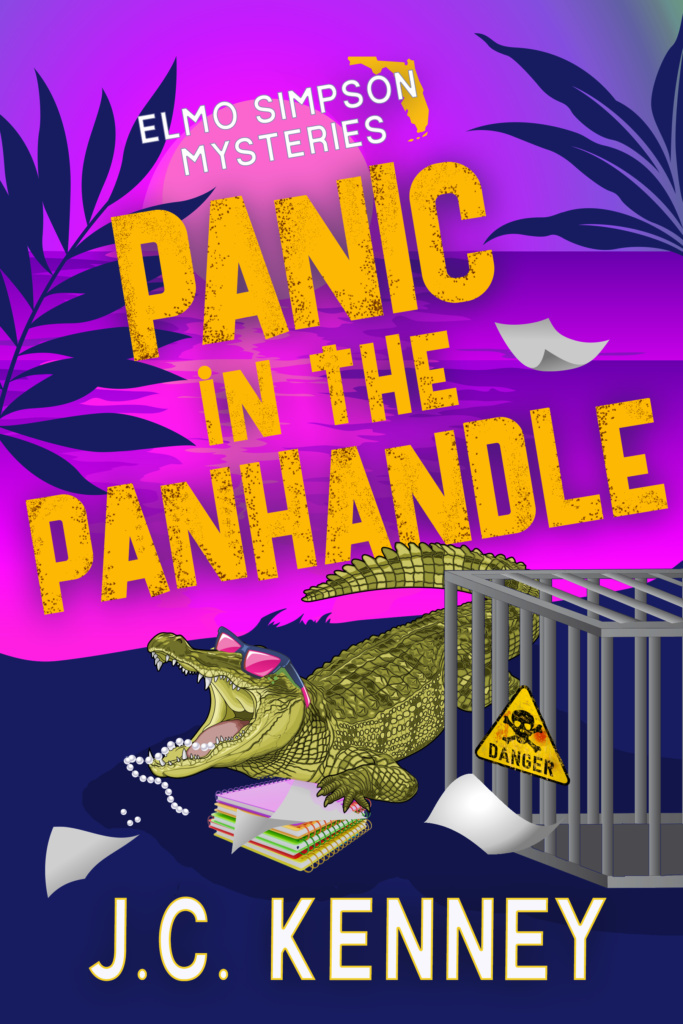
Hello and welcome! First and foremost, congratulations on the release of your Tule debut, Panic in the Panhandle! I know that I’m excited about your release day, so let’s jump right in, shall we?

1. Tell us about a moment when you were scared while writing your most recent mystery/thriller?

When I started writing it! Seriously, I always start a new story wondering whether I can pull it off. Can I write an engaging mystery? Will it be good enough? Will my editor hate it? Will I even be able to finish the darn thing. Those are always scary thoughts. I’ve learned I have to shove them aside and power through the doubt.

2. What secret have you kept hidden – until now?

When I was a senior in high school, a rival school spray painted graffiti on our baseball diamond. I was part of a group that returned the favor one foggy Saturday night. We dug up home plate and tossed it over the center field fence. We planted a mail box at first base. We took the tarp that was covering the pitcher’s mound, spray painted “The Rat Patrol” on it, ran it up a nearby flagpole, then made our getaway. We played that school later in the season at our place. Some friends held up a banner at the beginning of that game that said we led 1-0 because we stole home. As far as I know, the identities of The Rat Patrol are secret to his day.

3. Talk about a research result that horrified you and why you were researching it.

You know, I’ve been fortunate that most of the time, I’m able to conduct my research with a research perspective. I tend to look at things as a way to learn about unusual topics and how they may affect the human body. Though, to be fair, it was kind of disturbing when I was researching how one could commit murder by using an alligator. I used the research for Panic in the Panhandle. I won’t forget it any time soon.

4. What is the funniest feedback you’ve received on your book?

I don’t know that I’ve ever received feedback that was particularly funny. That’s okay, though. Most of the comments have been very kind. I’ll that that kind of feedback any day!

5. When did you know you wanted to write mysteries/thrillers? What led you to that genre?

I was writing in another genre when I shot my mouth off in my literary agency’s group chat. I responded to a photo another author posted by saying it looked like a good setting for a murder mystery. My agent replied by challenging me to write the story, which turned into A Literal Mess, which was published in 2019. I’ve had a ball writing mysteries ever since.

Thanks for joining us and congrats again on the release of Panic in the Panhandle!


About the Author

J.C. Kenney is the bestselling author of The Allie Cobb Mysteries, The Darcy Gaughan Mysteries, and The Elmo Simpson Mysteries. He’s also the co-host of The Bookish Hour webcast. When he’s not writing, you can find him following IndyCar racing or listening to music. He has two grown children and lives in Indianapolis with his wife and a cat.

Two Truths and a Lie About Tule Author Raemi A. Ray

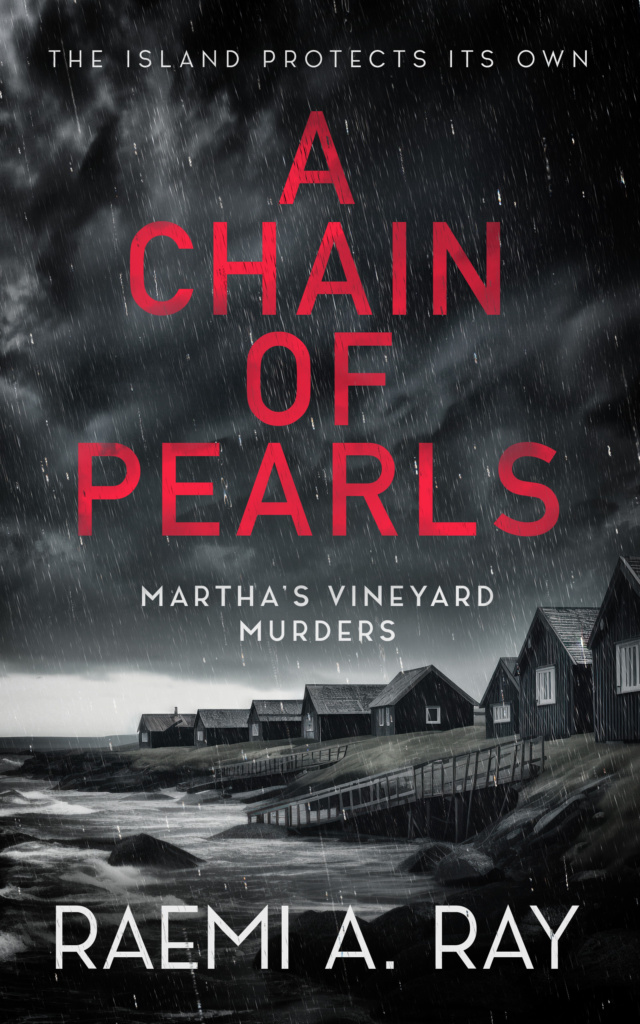
Raemi A. Ray’s Tule debut, A Chain of Pearls, is set to publish on April 9—the origin story for the investigative journey lawyer Kyra Gibson is about to embark on at Martha’s Vineyard to clean up after the death of her estranged father.

So we sat down with Raemi to get her origin story, too. Which of these “facts” isn’t true?

    1. Her pen name is actually her pet’s name, too.

    2. She finds inspiration for her mysteries by pulling from news headlines and adding in a murder.

    3. She has a side gig reviewing book covers on social media.

 Raemi set her series in Martha’s Vineyard because she started popping over to the island for summer holidays with friends while she was at university in Boston. Eventually, she started hanging out there for weekends and more throughout the year, too. It became her escape from city life. “It’s such a unique place, being quintessential New England but having its own identity so different from Nantucket and Cape Cod,” she says.

To experience her Martha’s Vineyard, take an umbrella and find a spot on South or State Beach in the summer to enjoy the ocean, or take a drive to Aquinnah or a boat ride around Chappy. If you’re there in August, she recommends the lantern festival and end-of-season fireworks. In the spring and fall, she often explores the trails near Felix Neck or shops and eats her way through OB and Edgartown.

At night? She could be scouring newspapers for interesting news. Or you could find her with her computer, reviewing book covers. A Chain of Pearls, of course, gets a 5-star rating. “Part of the book takes place in the real-life fishing village of Menemsha during a nor’easter. Nor’easters are these New England storms sort of like winter hurricanes with lashing rains and high winds,” she explains. “They often hit the islands. I think the cover embodies the feel of a deserted seaside town during such a storm. It’s foreboding and dark but not unrealistic.”

Home is where her heart is, as her idea of a perfect way to celebrate this debut would be to curl up with a glass of wine, a book, and her house demon, DolphLundgren—her reading buddy-slash-heating blanket. In this respect, she’s very much like her character, Detective Tarek Collins, who is quiet and reserved, more likely to observe the world around them.

“But I’m sure someone will drag me out to celebrate!” she adds. Perhaps that will include her childhood friends, the ones who nicknamed her Raemi Ray.

A Chain of Pearls was a 2022 Killer Nashville Claymore Award finalist. Pre-order your copy today!!


About the Author.


Raemi Amanda Ray is the author of A Chain of Pearls, her debut and the first book in a Martha’s Vineyard Murders series set on Martha’s Vineyard. Her travels to the island and around the world inspire her stories. She lives in Boston.