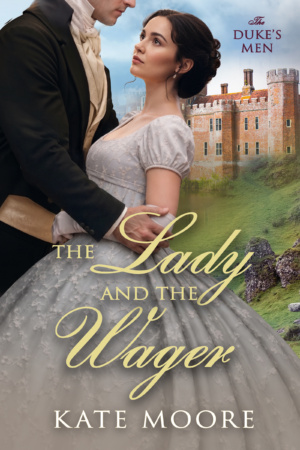
Start reading this book:
Chapter One
The Lodge of Delamere Castle, at a distance of nearly a mile from the castle itself, was a handsome edifice of ancient stone with a sharp-pointed roof, designed to impress a visitor. As a residence for a lively family of six, their cook, a maid, and a man of all work, it was less impressive—cramped, cold, and bare of comforts.
Cordelia Staveley, at twenty-two the eldest of the Staveley siblings, resigned herself to the inconveniences of the moment, but nevertheless, it was her aim to see her family restored to their proper home in the castle as soon as an arrangement could be struck with the new holder of the deed gambled away by their father. They had received no word from Viscount Graymont, but Cordelia had spent days imagining a meeting with him, arranging in her mind the arguments she would make in favor of her position.
A modest breakfast on a plain deal sideboard in what passed for the dining room was reminder enough of how low their branch of the family had sunk. She helped herself to an egg and toast with a bit of marmalade, and set herself to lift the spirits of her brother and sisters on this day of days.
“We will weather this, you know,” she said to her siblings, hunched over plain Staffordshire plates at the table.
They were considered a handsome family that came in two distinct versions of the Staveley look. Cordelia, her sister Rosalind at eighteen, and Miranda, a lovely girl of seventeen, had dark hair with fiery red strands, pointed chins, and blue eyes. Her brother Henry, twenty, his twin, Ned, away in the British navy, and their youngest sibling, Viola, a girl of fifteen, newly returned from school in London, had fairer looks, hazel eyes, curling wheaten locks, and squared jaws.
At Cordelia’s greeting, no one looked up. Viola had yet to make an appearance at the breakfast table.
Roz pushed a bit of egg across her plate with a sigh. “So you say, Cordelia, but really it’s quite hopeless, isn’t it? No one will want anything to do with a family such as ours.”
“We still have the land.” Henry looked up from his Almanac. Her brothers were mad for the sea, and Cordelia was grateful that Henry, deprived for the moment of his naval commission, was making an effort to learn estate management. “If I can understand this planting plan, we may have a harvest this year.”
“That’s all very well for you, Henry, but we ladies need dowries, not bulging hayricks,” Miranda replied. Her interest at the moment centered on the curate of St. Nicholas, Christopher Hartley.
“And a Season,” added Roz. “If I don’t have one this year, there will be no point. I’ll never have one.”
“And our Midsummer ball,” added Miranda. “We will never find husbands if we can’t dance.”
Cordelia set down her plate. “Do not look so far ahead, dear ones. We must manage to get through today, as lowering to one’s spirits as it is. Once we are back in the castle, our fortunes will improve.”
Roz threw her napkin onto the table. “I don’t want to return to the castle, Cordelia. I want to go to London. I want a Season. You don’t care what becomes of us. You care only about that ridiculous pile of stones.”
Cordelia wanted to protest the injustice of the accusation, but she held her tongue. Roz was not quite finished.
Roz pushed back in her chair. “Miranda can’t marry her wretched curate without a dowry. No one will do anything to promote Henry’s advancement in the navy, or Ned’s. And without more schooling, Viola will never acquire even a modicum of self-control. Face it, Cordelia, our family is doomed.”
“We could appeal to Uncle Richard again,” Miranda suggested. “He is a Staveley. He could do something for Henry and Ned.”
“We could if Cordelia’s pride were not in the way,” Roz replied.
Cordelia had to speak. “It is not a matter of pride, Roz. It’s a matter of the happy indifference of East Kent wealth. Uncle Richard has made it clear that he is not inclined to do anything for us. Where is Viola, by the way? She can’t still be in bed.”
“She isn’t. She was up and gone before I came down,” Miranda said.
“Gone?” Cordelia glanced at her cooling egg. Her stomach grumbled, but the first twinge of unease undid her appetite. She put down her fork and pushed back in her chair.
A heavy knock sounded on the lodge door. Quick footsteps passed in the entry, and the old door creaked open. The rumble of a male voice filled the hall, and Alice, their maid, came to find Cordelia.
“It’s Miss Viola,” Alice said.
Cordelia was already on her feet, heading for the door.
A rough-looking carter of imposing dimensions stood on the step, twisting his cap in his hands. “Beggin’ yer pardon, miss,” he said, “Tryin’ to do our job. Need yer ’elp.”
“Yes.” Cordelia waited for him to explain. A cool breeze off the Channel with a hint of rain in it ruffled her skirts. Behind her, Roz and Miranda peeked out at their visitor.
He gave another twist to his cap. “There’s a lady, miss, ’oo ’as tied ’erself to the piano. Won’t budge. We don’t wish to offend, miss, but we ’as a job to do.”
Roz gasped. Miranda somewhat ineffectively stifled a giggle. “O, Viola!”
“Of course, Mr. …?” Cordelia maintained her composure.
“Botley, miss, of Botley & Sons Haulers.”
“Very well, Mr. Botley. I will come to the castle directly.” Cordelia spun. Her sisters had vanished. She checked the dining room, but even Henry had disappeared. She grabbed a shawl, no time for a bonnet, but as an afterthought, she stopped in the kitchen for a short, sturdy knife.
Maximillian Rayne, Lord Graymont, waded up the shingle through stinging surf after his morning swim, much restored. He’d spent an uncomfortable night at a local hostelry in nearby Clifton-on-Sea and was resolved not to repeat the experience. From the spot where he’d left his clothes, the crenelated top of Delamere Castle peeked into view above the trees, catching the sun’s early rays. He shook his head, toweled off with his cravat, and pulled on his shirt.
Delamere stood not half a mile from the shore above a sloping grassy decline, where in some past age, the cliff had crumbled into the sea. It was a short, squat edifice built on the grounds of a former abbey. Four towers stood around a central courtyard, and outbuildings sprawled to one side. One could not call it imposing. It had neither the height of neighboring Corfe Castle nor the grandeur of Windsor. Toward the sea, its lichen-crusted stone exterior suggested not strength so much as a stubborn unwillingness to yield. He suspected that living in the castle meant accustoming oneself to various discomforts. Gray grinned. That was the beauty of the place—its positively medieval inconvenience. Castle Inconvenience, he would call it.
He laughed. His older sister, Bernice, and his younger brother, Lionel, would hate it. They might denounce his latest architectural folly, but the threat of a visit from either of his siblings was unlikely. He knew from the moment he plunged into the sea that as long as he chose to reside at Delamere, he would be free of their interference in his life.
On the whole, he thought as he dressed, his unexpected acquisition pleased him. He had Tom Winter, his very capable man of business, to deal with any inconveniences that might arise. That was Winter’s job, and Winter had everything well in hand. The castle’s former occupants had removed to the lodge. The castle’s contents were to be auctioned, and once the place was emptied, Gray would sell the stones. The only remaining problem was how to gain title to the land itself. Sir Humphrey Staveley, its previous owner, had acquired the castle and estate by marrying Lady Catherine Leigh-Hunt. An obscure clause in the title documents meant that none but her descendants could own the acreage. That very clause had kept Sir Humphrey Staveley, who was up to his coat lapels in debt, from securing a mortgage. Instead, Staveley had used the deed as collateral in a card game, thinking to recoup his losses. Gray’s solicitor jested that Gray could simply marry one of Staveley’s four daughters. Gray encouraged the man to find a way to break that clause or find another client.
Gray shrugged into his coat and gathered his stockings and boots. He took the path up through tangled shrubbery, ready to inspect his new property. A half-dozen drays lined the drive outside the north entry, laden with the contents of the castle, covered in roped-down canvas. But there was no movement, no bustle. A group of carters stood to one side of a narrow stair that led through an arch to the inner courtyard.
The men laughed and smoked their pipes.
“What’s the delay?” Gray asked a fellow who was tapping his pipe on the heel of his boot.
“A troublesome woman.” The fellow spat. “Chit’s mad as a hatter. She’s tied ’erself to the piano.”
Gray took the stairs. He was well-acquainted with troublesome women, the sort that put a man off marriage entirely. His mother had been such a woman, and his sister, Bernice, had inherited the same controlling qualities.
Inside the courtyard, the scene that met his gaze appeared fit for the stage of a melodrama. Rays of sunlight through the gathering clouds made pools of light on the stones, and a cool ocean breeze snapped a flag on the battlements above. A line of objects apparently abandoned by the haulers crossed the courtyard—a gilded red velvet bench, two large jade porcelain lions, a rolled-up carpet, and a four-poster bed. Winter stood at the rear of the line of objects with a sheaf of papers in his hand, looking on. Staring at Winter with unnerving intensity was a large gray lurcher, the dog’s posture indicating a readiness to spring.
In the center of it all, a girl of fifteen or sixteen, clad in black silk, lay draped over a mahogany piano. Ropes bound her torso and legs. One pale hand gripped the mahogany edge of the instrument, and the other lay across her brow. Her feet dangled off the near end of the piano, and her long, honey-colored hair flowed over the far end. Standing next to her, speaking in a voice so low he could not make out the words, was another woman, older by a few years, and to judge by her expression, severely vexed. In her hand was a short, sharp-looking knife.
The black-clad maiden in her attitude of sacrificial victim was meant to draw the eye, but Gray could not look away from the woman with the knife. He judged her to be on the wrong side of twenty, as neat and contained as the girl in black was not. There was nothing remarkable in her sea-colored muslin gown or slight figure. She appeared to have both the coolness of temper and strength of will that made a good card player. Sunlight caught unexpected fiery strands in her dark hair, and her eyes flashed briefly with an emotion he could not name.
He moved closer, drawing the dog’s notice and a nod from Winter. Neither of the women appeared to see him.
“We missed you at breakfast, Viola,” said the woman in the watery-colored gown.
“Surely, Cordelia, you knew that I would not stand idly by while barbarians pillage our house.”
“Lying on Mama’s piano is a better strategy?”
“It’s working, isn’t it?”
The woman in sea blue did not reply. Their names meant nothing yet, but Gray guessed that these were two of Staveley’s daughters. He noted the straightness of the elder sister’s spine in contrast to the curving lines of the younger.
The silence stretched until the girl in black peeked from under the arm hiding her face. “We can’t let strangers take away every memory of Mama.”
“Of course not. Shall I bring some breakfast, then? Your stay is likely to be a long one. And it may be damp, as well. That breeze means rain is likely.”
“Don’t worry about me. I will endure.”
“Viola, we will not forget Mama. We simply agreed to part with certain furnishings in order to pay Papa’s creditors.”
“I did not agree. Delamere has a perfectly good dungeon. What we should have done was lock Papa in it.”
“Why did I not think of that! A missed opportunity.”
“You did not think of it because you always expect people to behave well.”
“How very foolish of me.”
The girl in black lifted her head and leaned back on her elbows. Her gaze found Gray. “Who are you?” she asked.
Gray set down his boots and strolled forward. “I’m Graymont.”
“Our oppressor!” cried the girl. She struggled to sit up against the ropes. The dog gave a sharp bark.
“Lord Graymont,” said the other with a brief curtsy. “Hector,” she called the dog, and the beast trotted to her side and sat. The girl in black attempted to squirm out of her bindings. Her sister pushed her down and applied the knife to a strand of rope, cutting through it easily.
Cordelia turned to the viscount. Her prepared arguments went out of her head. The gentleman in front of her was not the dissipated crony of her father’s that she’d been expecting–an inhabitant of the London clubs, a card player, rumpled and reeking of smoke and spirits. Graymont was young, perhaps not thirty. Damp locks of dark hair curled around a lean face. His collar lay open, exposing the strong, sinewy column of his throat. His bare feet were planted firmly on the courtyard stones. Sand clung to his toes. With a shock of recognition, she realized that he’d been for a swim. At her beach.
While she had been nerving herself to face the loss of her home’s furnishings, the new owner of Delamere had been on a sea-bathing holiday. He had descended to the beach, stripped, and plunged into the surf, pitting his strength against tide and current, indifferent to the frigid waves. She reached out and put a hand on Hector’s head. Everything about Graymont suggested the ease and command of a man who might do whatever he wished with his property. Oh, Papa, what have you done to us!
She curled her fingers into Hector’s fur and squared her shoulders. “My lord, you are welcome to Delamere.”
“Am I?” His dark brows went up. His gaze bordered on uncivil, as if he were weighing an adversary. He turned to his man. “Winter, is this piano on the list of furnishings to be auctioned?”
The man, Winter, made a show of flipping through the sheaf of papers in his hand. “Let me look, my lord. Here it is. Square piano, mahogany case, satinwood name board, square cartouche by Clementi & Sons, uh”—Winter glanced at Graymont and received a look Cordelia could not read—“to be moved to the Lodge.”
“Very well then, Miss …” Graymont turned to Viola.
“Viola Staveley. I’m the youngest of the tribe.” Viola shook off the severed rope and leapt down from the piano. “You don’t look like a viscount.” She stared at him with all the frankness of her nature.
“Viola!” Cordelia admonished. “My lord, please pardon my sister.”
“You have some notion of how a viscount must look?” he asked, looking not at Viola but at Cordelia. Again, she felt herself measured and dismissed.
Viola chattered on. “Well, of course, we thought you’d be older to be playing at cards with Papa, didn’t we, Cordelia? And more stou—”
“Viola, enough!” Cordelia said. “Thank you, Lord Graymont, for clarifying the status of the piano. It was our mother’s, and naturally, Viola is attached to it.”
“You mistake me, Miss Staveley. No thanks are due. Naturally, you want your father’s creditors paid as soon as possible to preserve whatever you can of your family’s reputation.”
“Naturally,” she said through gritted teeth. He was deliberately provoking, reminding her of their family’s disgrace and her helplessness.
“Then we are in accord. I trust my men may continue their work without further interference or delay.” He nodded to Winter. “And, Winter, can you arrange an apartment for me here?”
Winter nodded and crossed to the courtyard entrance. Graymont’s gaze swept the courtyard. “I wouldn’t house my dogs at the local inn.”
Viola’s mouth opened, and Cordelia squeezed her sister’s hand hard. “You’re going to live here?” she asked the viscount in what she hoped was her ordinary voice, and not the one shrieking No! in her head.
“My prerogative, I believe.” His gaze came back to her. “I will remain until the auction is concluded, and I decide on the most profitable way to deal with the castle.”
“Profitable way? I don’t understand.” At least she was trying not to. He meant to remain at Delamere for thirty days, and to profit from the castle in some way.
The carters began to file back into the courtyard. Two of them picked up the gilded velvet bench from the foot of her mother’s bed.
“There’s an ancient building practice,” Graymont said, “reusing materials. Delamere’s stones alone are worth a good bit. I don’t doubt the timber can be sold as well.”
“So, you would take the castle down? It’s been here since 1356.” The idea of taking it down had never occurred to her. She had assumed the new owner would take little interest in a place so far from London, that Papa’s debts would be paid, and that they would soon be home.
“As I say, I’ll have to see what can be done. Now, you must excuse me.” With a nod Graymont picked up his boots and walked away across the courtyard toward the southeast tower stairs.
“Come, Viola,” Cordelia tugged her sister into motion. She snapped her fingers and Hector followed. At the arch, Viola turned back. “Lord Graymont, if you’re going to stay here, you should know, the beach is Cordelia’s beach. She swims there.”
End of Excerpt