


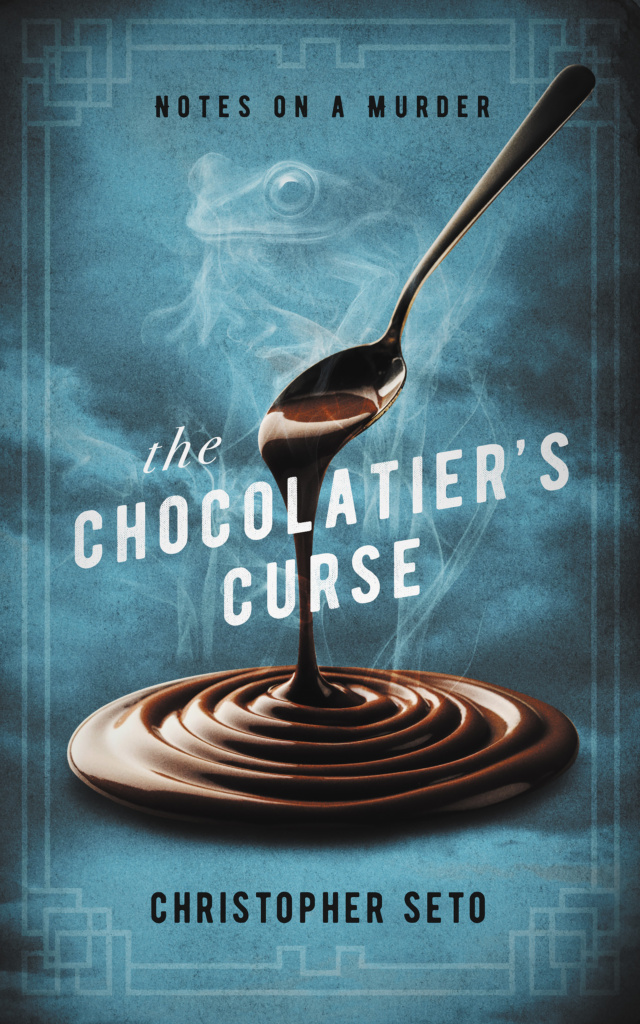
 I am a longtime fan of Agatha Christie’s books, and her stories had a strong influence on my own writing. So, when I was asked to write a post for the Tule Blog ahead of my first novel coming out (The Chocolatier’s Curse, to be released on November 5), I thought it might be fun to compile a list of my all-time favorite Christie novels. But first, a couple of notes:
Christie lived from 1890 to 1976. Like much British literature produced during this time, her writing includes racist slurs and orientalist / antisemitic tropes (though some of this has been removed in later editions). I mention this as something of a content warning, and also because I think it is important for readers to be clear-eyed about how social inequality is reflected in—and reinforced by—fiction. Even (especially?) when it comes to books we really enjoy.
Second, I’ve only read about forty of Christie’s sixty-six crime novels, so my list might be incomplete. I haven’t had much time for recreational reading lately, but I’d like to finish the other twenty-six at some point. Maybe then I’ll post an updated ranking! Until then, here are top ten favorite Agatha Christie novels (Summaries are based on my memories with some support from Wikipedia for character names and things like that).
10. Evil Under the Sun: Poirot goes on vacation—and immediately becomes embroiled in a murder investigation when another guest at his resort is strangled on a secluded beach. Between the setting and the complicated romantic and familial relationships, this one reads a bit like a season of The White Lotus. And I thought the solution was particularly clever. Fun fact: this book is Theo Chan’s recreational reading choice in The Vanishing Stone, which is also set on an island.
9. Sleeping Murder: One of the creepier entries on this list for sure, and a great read for spooky season. Miss Marple assists Gwenda Reed, who has recently married and moved into a new house, where she begins experiencing some unsettling premonitions and déjà vu … featuring a murder that may or may not have happened. Themes of memory and ghosts from the past.
8. Murder on the Links: In writing this list, I realized that a lot of my favorite Poirot mysteries are those narrated by Hastings. This is their second case together (the first being The Mysterious Affair at Styles), and it does a good job filling out their relationship a bit. The duo investigates a stabbing in France, where Poirot has to compete with a police detective who really doesn’t like him, and Hastings gets his own little subplot.
7. Five Little Pigs: Sixteen years ago, Caroline Crale poisoned her husband … or did she? Before dying in prison, she claims to be innocent. Poirot’s investigates the murder on behalf of Caroline’s daughter. I particularly enjoyed the “cold case” set-up of this one, as well as the very limited suspect pool.
6. Curtain: Poirot’s Last Case: Poirot and Hastings reunite for one last time in pursuit of a very peculiar sort of murderer. It is quite a “full circle” moment for them, as the setting is the same as their first case. In addition to an entertaining puzzle (and satisfying conclusion to the story of Hercule Poirot), I found it to be something of a meditative reflection on aging and the passage of time.
5. Endless Night: There’s something different about this book, compared to Christie’s other works. It feels darker, dreamlike, and decidedly less cozy than average. The story is narrated by Michael Rogers, who decides he’d like to have a house built for himself on some supposedly cursed land. This goes about as well as you might expect.
4. The Moving Finger: Technically a Miss Marple mystery, though she is less present throughout than in many of her other stories. The book centers on a village shaken by a series of anonymous “poison pen” letters accusing residents of various misdeeds … a situation that soon turns deadly. This book highlights one of my favorite things about Christie’s writing: the way she structures her plots around tight-knit social networks. It is also an interesting examination of the social costs of disinformation—and published several decades before the invention of the modern internet!
3. The A.B.C. Murders: Poirot and Hastings investigate a strange sequence of alphabetical murders. The killer sends Poirot letters about each upcoming death, and the victims appear to be targeted solely based on their initials. Serial killers don’t feature very often in Christie’s work, so I found the premise of this one fun and refreshing.
2. And Then There Were None: It feels a bit cliché to include the bestselling mystery novel of all time on my list, but here we are. Ten strangers embark on an island getaway, which ends up being a lot less relaxing than it sounds for pretty much everyone involved. Great plot structure and totally worth the hype.
1. Crooked House: And now we’ve reached my very favorite. Crooked House is a murder mystery structured around that timelessly awkward experience of meeting your significant other’s family for the first time. Charles Hayward and Sophia Leonides are planning to marry. But when Sophia’s grandfather is poisoned, she tells Charles they need to put their engagement on hold until the murder is solved. This spurs Charles to investigate, aided by his police commissioner dad and the actual detective assigned to the case. Unfortunately, Sophia’s relatives all live in the same, giant (crooked) house—and nearly all had reasons to want her grandfather dead. Great premise and absolutely wild conclusion.
About the author

Chris earned his Ph.D. in criminology from Penn State and is presently an assistant professor at Purdue University. When not writing about fictional or non-fictional crimes, he enjoys reading, origami, and performing sleight of hand-based magic tricks. Chris lives in Indiana with his wife, daughter, three cats, and one lizard. You can connect with him on Bluesky.

Which two do you think The Chocolatier’s Curse would set between on a bookshelf, Chris?